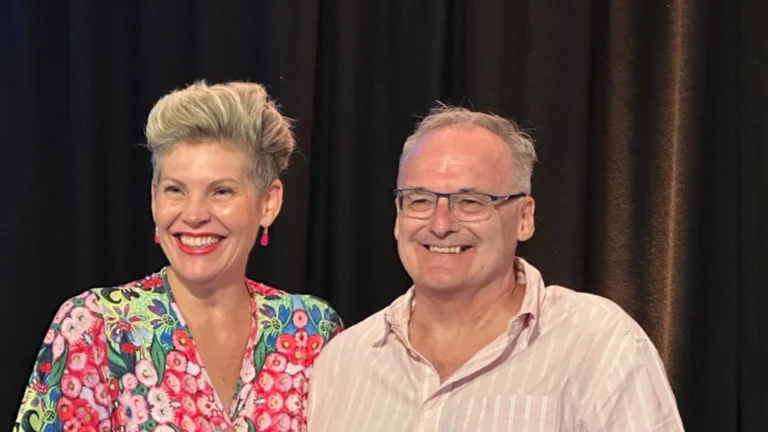
The Justice and Equity Centre has filed a disability discrimination claim in the Federal Court on behalf of Sean Senbel-Lynch, a teenager with cerebral palsy, a visual impairment and epilepsy. Sean was left stranded in Port Vila, Vanuatu, when the Australian Government refused to let him on any of the Australian Defence Force (ADF) flights used to evacuate hundreds of other Australians following a 7.3 magnitude earthquake.
‘I remember the ground shaking very hard,’ says Sean. There was a very loud rumbling noise, mixed with the sound of things breaking and falling. When the shaking finally stopped, everything went quiet. The silence afterwards was eerie.’
Sean was in Vanuatu with his mother and sister, visiting his grandmother. The earthquake caused significant structural damage to his grandmother’s home, including partial ceiling collapse, cracked walls and buckled floors.
The family had no electricity for around 4 days and no running water for 3 days. The power outage meant the daily growth hormone medication Sean takes to manage his growth and development-related impairments was destroyed. Because of startle reflexes associated with his cerebral palsy, the aftershocks left him in a heightened state of alert and distress. His visual impairment made it difficult to understand what was happening around him. As the aftershocks continued, Sean was fearful of leaving his wheelchair to sleep in bed, in case his grandmother’s home further collapsed.
As the Port Vila airport was closed to commercial flights, Sean’s parents made repeated appeals to the Australian embassy and departmental staff for assistance to evacuate Sean. The family were told the ADF flights were not suitable for Sean and he could not be evacuated.
‘I felt I should at least have been assessed in person to see whether I was fit and suitable to travel on an evacuation flight, instead of people making assumptions about what I could or couldn’t do,’ says Sean.
‘I felt anxious and frustrated because I didn’t feel there was any real help from the government agencies. I felt guilty as well. I thought I was holding back my mum, sister and grandmother from getting to a safe place. That was a very hard thing to feel.’
Because of his disability Sean uses a manual wheelchair to help with mobility but can walk with assistance or by holding on to supports. When he boards flights, he walks onto the plane himself with minimal support and travels in a standard seat.
Sean’s father Liam Lynch was in Australia, trying to get his family home safely. ‘Based on my dealings with DFAT, I was concerned there were serious failures in decision-making, coordination and crisis management,’ says Liam.
‘There was no clear planning for passengers with disability, and there was an unwillingness or inability to make timely decisions about my son’s evacuation.’
‘I repeatedly sought clarification about what policies, directives or protocols were being applied to decide who could travel on official flights. I didn’t receive a clear explanation. Instead, responsibility appeared to shift between agencies, with no one taking ownership of the decision.’
Sean finally returned home to Brisbane on a commercial flight 5 days after the earthquake struck, when Port Vila airport re-opened to airlines.
In the days after the earthquake, 10 ADF flights evacuated 686 Australian citizens, permanent residents and their families, and approved foreign nationals.
‘I’m going to Court because it’s important government agencies are held accountable for the way they respond in times of crisis, especially when their decisions affect vulnerable people,’ says Sean.
‘I’m hoping the case leads to change, so in future crises, people with disabilities are treated fairly, assessed properly, and not left behind.’
Quotes attributable to Nicola Colagiuri, Senior Solicitor at the Justice and Equity Centre:
‘While other Australians were evacuated quickly and safely on Australian Defence Force flights, Sean was excluded and told his disability meant he would not be able to board. This raises questions about how decisions were made.’
‘Australians expect their government to take reasonable steps to help them if they’re stranded overseas because of a major emergency. Sean just wanted to be transported home like the hundreds of other Australian citizens and residents who were given help.’
Australian law recognises that people with disability should have equal access to services, including services provided by the Australian Government. And service providers are required to make reasonable adjustments for people with disability.’
‘In Sean’s case, it’s not clear the government agencies involved properly assessed Sean’s ability to board any ADF aircraft or considered what adjustments could be made to allow him to travel.’
‘As international instability and the risk of natural disasters rise, Australian government agencies must take immediate steps to ensure disaster and emergency responses are accessible, inclusive and responsive to the needs of the one in six Australians who live with disability. People like Sean must not be left stranded in high-risk and traumatic situations.’
Media contact: JEC Media and Communications Manager Dan Buhagiar, 0478 739 280